The ISO 8000 data quality series — a guide for data owners
What the ISO 8000 data quality series is and why it exists
Every organization depends on data. Purchase orders reference product identifiers. Maintenance systems record equipment properties. Supply chains exchange descriptions of goods. When those data are wrong, ambiguous or untrustworthy, the consequences range from minor inefficiency to significant financial and safety risk: the wrong part ordered, the wrong asset maintained, the wrong shipment dispatched.
The ISO 8000 data quality series is the international standard series that addresses this problem systematically. It provides agreed definitions, technical requirements and management guidance that allow organizations to characterize, exchange, assess and improve the quality of their data. It does not prescribe which software to use or how to organize an IT department. It provides the vocabulary and the rules so that people inside and between organizations can discuss data quality precisely and act on it consistently.
The series is published by the International Organization for Standardization (ISO) under Technical Committee 184, Sub Committee 4 (Industrial data). The technical development of the series is carried out by TC 184/SC 4/WG 13 (Working Group 13), whose title is “Industrial data quality”. It is relevant to any organization that creates, receives or depends on structured data; not only manufacturers or engineers.
The phrase “data quality” in the name of the ISO 8000 data quality series derives directly from the title of Working Group 13. ISO document titles are taken from the title of the working group responsible for their development. Working Group 13 is titled “Industrial data quality”, the series title however, uses “data quality” without the qualifier “industrial”. This is a decision taken by ISO reflecting the reality that the scope of the series extends beyond industrial contexts, and therefore the word “industrial” does not appear in individual document titles.
The word “industrial” in the title of Sub Committee 4 should itself be understood in the same expanded sense as the term “master data”: that is, data held by an organization to describe the entities that are both independent and fundamental for that organization, and referenced in order to perform its transactions.
Certain parts of the ISO 8000 data quality series are formally designated by ISO as Horizontal standards. This designation signals that the scope of those parts extends beyond any single industry sector; the requirements apply wherever structured data are created, exchanged or managed, regardless of whether the context is manufacturing, energy, life sciences, financial services, government or any other domain.
The ISO 8000 data quality series is actively evolving. Some published parts are currently being revised: ISO 8000‑2:2022 (vocabulary), and ISO/TS 8000‑60:2017 (data quality management overview). During this transition, the published editions remain the most recent available text for those subjects, but readers should note that revised editions are in preparation. The summary below covers only parts that are current, that is, published and not yet superseded, together with parts at active development stages (AWI, CD, DIS) where the subject matter is relevant to the overview.
The structure of the series
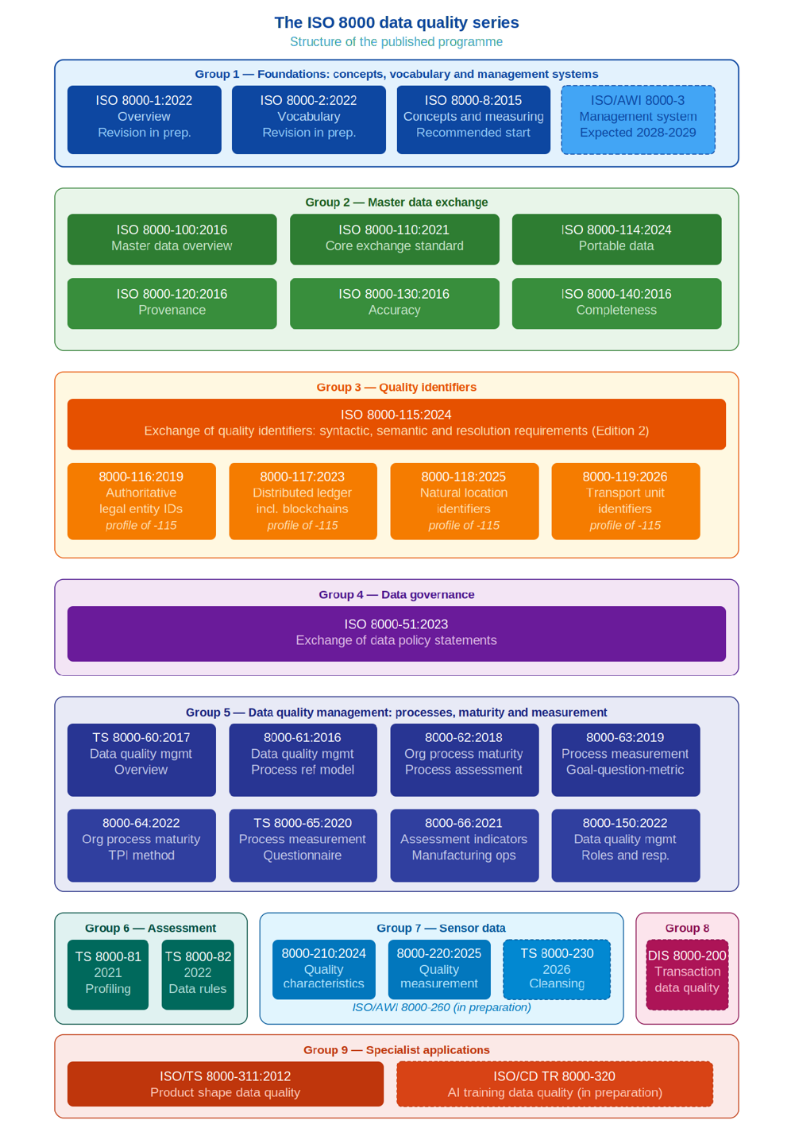
Group 1 — Foundations: concepts, vocabulary and management systems
ISO 8000‑1:2022: — Overview provides a map of the series, states its overall scope, establishes the principles of information and data quality and describes the relationship of the ISO 8000 data quality series to other international standards. The current edition remains in force.
ISO 8000‑2:2022 — Vocabulary (current edition; revision in preparation) defines the terms used consistently across the ISO 8000 data quality series. The current edition remains normatively in force pending publication of its successor.
ISO 8000‑8:2015 — Information and data quality: concepts and measuring describes the fundamental concepts of information and data quality and how those concepts connect to quality management processes and quality management systems. It is accessible to a reader without a technical background and is the recommended starting point for anyone new to the field.
ISO 8000‑8 establishes the essential insight that data quality is not an intrinsic property of data in isolation but is always relative to a purpose: data that is fit for one use may be wholly unfit for another. This framing shapes the approach of every subsequent part in the series.
ISO/AWI 8000‑3 — Information and data management systems: requirements with guidance for use (publication expected 2028 to 2029) is being developed as a Type A Management System Standard (MSS). When published, it will be the most foundational part of the ISO 8000 data quality series for organizations seeking formal, certifiable governance of their data.
Type A MSSs specify requirements that an organization shall fulfil to demonstrate conformity; they are the most widely purchased category of standard in the ISO portfolio (ISO 9001 for quality management and ISO 27001 for information security management are well-known examples of the same document type). ISO/AWI 8000‑3 will specify requirements for establishing, implementing, maintaining and continually improving information and data quality within the context of an organization, covering all of the following:
— all processes that generate, obtain, confirm, transform, retain, retrieve, disseminate and dispose of data;
— all processes that plan, control, assure and improve data quality;
— all kinds of data, including but not limited to master data, transaction data and industrial data.
ISO/AWI 8000‑3 will be compatible with the harmonised ISO High Level Structure used by ISO 9001 and ISO 27001, enabling organizations to integrate it with existing management systems without duplication. It will be applicable to any organization, regardless of size, type or nature, that manages data of any kind.
Organizations that currently apply ISO 8000 data quality series requirements selectively should consider the significance of this development: ISO/AWI 8000‑3 will provide the overarching management system framework within which all other parts of the ISO 8000 data quality series operate.
Group 2 — Master data: technical requirements for exchange
Master data are the persistent, shared data that describe the things an organization operates with: products, equipment, materials, locations, suppliers and customers. It is the most demanding category of data to manage well because it is referenced repeatedly across many systems and transactions.
ISO 8000‑100:2016 — Master data: exchange of characteristic data: overview describes the scope and architecture of the master data quality parts of the ISO 8000 data quality series. It explains the bottom-up approach: quality is assessed at the level of the individual property value, not the record or the system. The current 2016 edition remains normatively in force.
ISO 8000‑110:2021 — Master data: exchange of characteristic data: syntax, semantic encoding, and conformance to data specification (Edition 2) is the core technical standard for master data exchange. It specifies what a master data message shall contain and how its content shall be expressed so that a receiving system can verify, by computer, whether the data conforms to a stated specification.
The key concept is semantic encoding: rather than sending a plain text string such as “red” or “25 mm”, a conformant message references a dictionary entry that defines precisely what “colour” or “nominal diameter” means, so the receiving party knows unambiguously what the value represents. This eliminates the ambiguity that accumulates when data passes between organizations or between legacy systems.
ISO 8000‑110 is the foundation standard for the master data exchange sub-series. ISO 8000‑114, ISO 8000‑120, ISO 8000‑130 and ISO 8000‑140 all build upon it.
ISO 8000‑114:2024 — Application of ISO/IEC 21778 and ISO 8000‑115 to portable data addresses portable data: data that can be understood by a recipient without requiring access to the originating organization’s internal systems. This is relevant to any organization that supplies data alongside physical goods — for example, as part of a product passport, a digital twin handover package or a maintenance record — and needs that data to remain interpretable indefinitely. ISO 8000‑114 specifies the syntax, the metadata and the reference data that shall accompany portable data to achieve this.
ISO 8000‑120:2016, ISO 8000‑130:2016 and ISO 8000‑140:2016 supplement ISO 8000‑110 with additional requirements for specific quality dimensions of master data:
— ISO 8000‑120:2016 — Provenance specifies requirements for representing and exchanging information about where a master data value came from and when. It defines scenarios for data provenance and a conceptual model for provenance information;
— ISO 8000‑130:2016 — Accuracy specifies requirements for representing and exchanging information about the accuracy of master data values, in the form of statements and assertions;
— ISO 8000‑140:2016 — Completeness specifies requirements for representing and exchanging information about whether all required property values are present.
These three parts are optional additions to ISO 8000‑110: an organization implements them where its use case requires that level of assurance. Together, ISO 8000‑110, ISO 8000‑120, ISO 8000‑130 and ISO 8000‑140 address the properties: syntax; semantics; provenance; accuracy; and completeness, that determine whether a master data message can be trusted.
Note on ISO document type designators
The reference numbers used throughout this document carry prefixes and suffixes that indicate both the type of document and its stage of development. The following explanations are intended to assist readers who are unfamiliar with the ISO publication system.
International Standard (IS, no prefix designator). An International Standard provides rules, guidelines or characteristics for activities or for their results, aimed at achieving the optimum degree of order in a given context. It can take many forms: product standards, test methods, codes of practice, guideline standards and management system standards are all examples. A reference of the form ISO 8000‑110:2021 denotes a published International Standard, where 2021 is the year of publication.
ISO/TS (Technical Specification). A Technical Specification addresses work still under technical development, or where it is believed that there will be a future, but not immediate, possibility of agreement on an International Standard. A Technical Specification is published for immediate use, but it also provides a means to obtain feedback. The aim is that it will eventually be transformed and republished as an International Standard. ISO/TS 8000‑65:2020 is an example of a Technical Specification in the ISO 8000 data quality series.
ISO/TR (Technical Report). A Technical Report contains information of a different kind from that of the two preceding document types. It may include data obtained from a survey, an informative report, or information reflecting the perceived state of the art in a given area. A Technical Report does not contain requirements and is therefore not used for conformity assessment purposes. ISO/CD TR 8000‑320 is currently being developed as a Technical Report.
The following designators indicate documents that are in preparation and have not yet been published:
— AWI (Advanced Work Item) denotes the stage before a draft is circulated to the working group for comment. It records that a project has been approved and assigned but that no circulated draft yet exists. ISO/AWI 8000‑3 is at this stage;
— WD (Working Draft) denotes a draft that is circulating within the working group for technical development and comment. A working draft is not available outside the working group;
— CD (Committee Draft) denotes a draft that has been approved for circulation to the wider technical committee for comment. A committee draft is available to national standards bodies and registered experts but is not yet a public document;
— DIS (Draft International Standard) denotes a draft in the final stage before official publication. A DIS has been approved by the technical committee and is submitted to ISO member bodies for a formal approval ballot. ISO/DIS 8000‑200 is currently at this stage.
The presence of a type designator (ISO/TS, ISO/TR) on a published document does not diminish its technical authority. Many parts of the ISO 8000 data quality series have been published as Technical Specifications and are in full operational use, pending their eventual consolidation into International Standards.
In the next post in this series, we are going to make a provocation: that poor data quality is, at its heart, a leadership failure — not a technology failure. We expect some pushback. Good. That is the point.