The ISO 8000 data quality series — a guide for data owners
Group 7 — Sensor data
A distinct and expanding area of the series addresses data generated continuously by sensors. Sensor data has different characteristics from periodically recorded master data: it is a stream of discrete digital values, it is generated at high volume, and its quality degrades in ways: anomalies; signal drift; missing values; that do not apply to manually entered records.
ISO 8000‑210:2024 — Sensor data: data quality characteristics defines the quality characteristics specific to sensor data streams. It specifies the types of anomaly that affect sensor data and the relationships between quality characteristics and anomaly types. It covers digital sensor data only; analogue, image, video and audio data are outside its scope.
ISO 8000‑220:2025 — Sensor data: quality measurement specifies quantitative measures for each of the quality characteristics defined in ISO 8000‑210. An organization can use ISO 8000‑220 to produce numerical assessments of sensor data quality that are comparable across systems and over time.
ISO/TS 8000‑230:2026 — Sensor data: guidelines for data cleansing provides guidelines for detecting and repairing the anomalies identified in ISO 8000‑210. It specifies the principles, the process and the implementation requirements for sensor data cleansing, together with a catalogue of anomaly detection and repair methods. Real-time processing is outside its scope.
ISO/AWI 8000‑260 — Sensor data life cycle management: concept and framework (no publication date) will extend this coverage to address the full life cycle of sensor data, including its characteristics in AI applications and monitoring and diagnostics environments.
Group 8 — Transaction data
ISO/DIS 8000‑200 — Transaction data: quality of transaction data (not yet published) addresses a category of data that is distinct from both master data and sensor data. Transaction data records what happened at a point in time: events, certificates, measurements and transfers. ISO/DIS 8000‑200 covers the characteristics of transaction data, the nature of its quality, how that quality changes over time and how it is managed.
Group 9 — Specialist applications
ISO/TS 8000‑311:2012 — Guidance for the application of product data quality for shape applies data quality concepts from the ISO 8000 data quality series to geometric shape data used in product design and manufacturing, with reference to ISO 10303‑59 (STEP quality of product shape data). It is the only current part of the series that addresses product shape as distinct from characteristic data.
ISO/CD TR 8000‑320 — AI training data quality for smart manufacturing (not yet published) will address data quality requirements specific to data sets used to train AI models in a manufacturing context. It is being developed as a technical report rather than a normative standard.
How the parts relate to each other
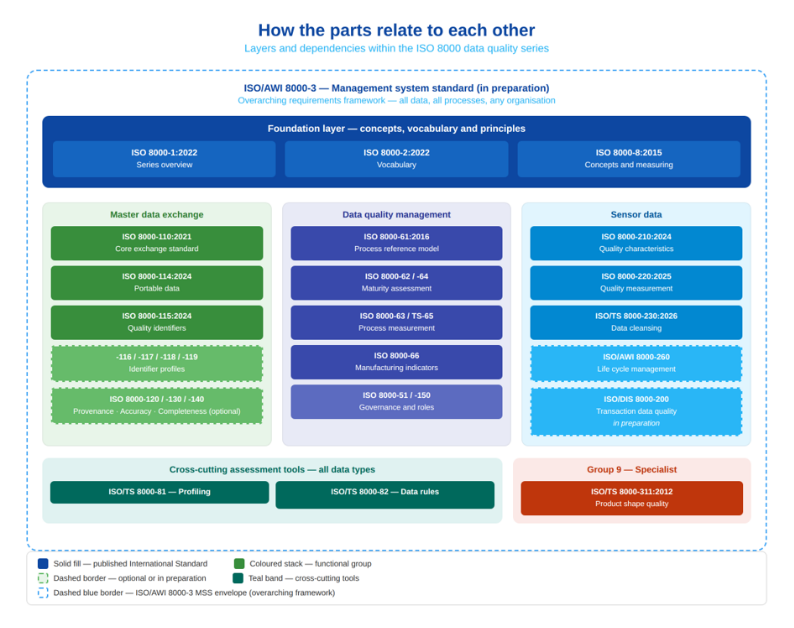
The ISO 8000 data quality series is cumulative. The master data exchange parts (ISO 8000‑110, ISO 8000‑114, ISO 8000‑115, ISO 8000‑116 to ISO 8000‑119, ISO 8000‑120, ISO 8000‑130 and ISO 8000‑140) form a technical stack: ISO 8000‑110 is the foundation for exchange; ISO 8000‑115 provides the identifier infrastructure; ISO 8000‑116 to ISO 8000‑119 profile that infrastructure for specific identifier types; and ISO 8000‑120, ISO 8000‑130 and ISO 8000‑140 add optional quality dimensions.
The data quality management parts (ISO 8000‑61 to ISO 8000‑66, ISO/TS 8000‑65 and ISO 8000‑150) form a process stack: ISO 8000‑61 is the process reference model; ISO 8000‑62, ISO 8000‑63, ISO 8000‑64 and ISO/TS 8000‑65 provide assessment and measurement tools; ISO 8000‑66 adapts the assessment for manufacturing; and ISO 8000‑150 addresses organizational governance.
ISO/TS 8000‑81 and ISO/TS 8000‑82 provide assessment tools applicable across all data categories. ISO 8000‑210, ISO 8000‑220 and ISO/TS 8000‑230 form a self-contained technical and procedural stack for sensor data.
ISO 8000‑8 and ISO 8000‑2 (and, in their current transitional state, ISO 8000‑1 and ISO 8000‑100) provide the conceptual and terminological foundation for the entire series. When published, ISO/AWI 8000‑3 will provide the overarching management system framework within which all other requirements of the ISO 8000 data quality series operate.
Who benefits and how
Data managers and data stewards will find that the process model in ISO 8000‑61 to ISO 8000‑66 provides an internationally recognised framework for describing, organizing and improving what they already do. The vocabulary in ISO 8000‑2 allows data quality to be discussed precisely with suppliers, customers and auditors without the ambiguity that informally defined terms introduce. The assessment tools in ISO/TS 8000‑81 and ISO/TS 8000‑82 provide structured starting points for a data quality improvement exercise.
Supply chain and procurement managers will find that ISO 8000‑110 and ISO 8000‑115 address a persistent operational problem: receiving product data from suppliers that is technically received but practically unusable because its meaning is ambiguous or unverifiable. A supply agreement that requires conformity with ISO 8000‑110 gives a buyer a computer-checkable criterion rather than a subjective judgement. ISO 8000‑114 addresses the related problem of data that arrives with goods but cannot be understood without reference back to the supplier.
Chief data officers and data governance leads will find that ISO 8000‑51 provides a mechanism for encoding data governance policies in machine-readable form, which is increasingly required under data regulation. ISO 8000‑150 provides a framework for assigning accountability for data quality across an organization. The forthcoming management system standard (ISO/AWI 8000‑3) will provide a certifiable framework compatible with ISO 9001 and ISO/IEC 27001 that governs all data in an organization, regardless of type or source.
IT architects and systems integrators will find that ISO 8000‑110 and ISO 8000‑115 define the technical requirements that a data exchange interface shall satisfy to enable automated quality checking at the point of receipt. The requirements are implementation-neutral and are designed to work with existing enterprise systems.
Operations and maintenance managers in asset-intensive industries will find that the sensor data parts (ISO 8000‑210, ISO 8000‑220, ISO/TS 8000‑230 and the forthcoming ISO/AWI 8000‑260) address the data quality challenges specific to continuous monitoring environments, and that ISO/TS 8000‑311 addresses shape data quality for engineering applications.
Starting points for common situations
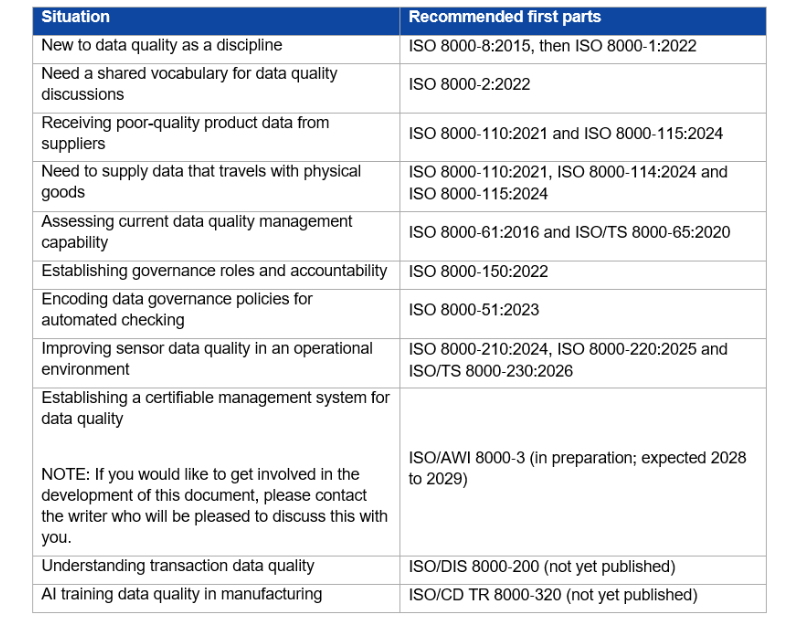
This is part 3 of 4 in the ISO 8000 data quality series guide, published as a weekly series.
Part 2 covered quality identifiers, data governance, and process maturity and measurement.
Part 4 covers how ISO 8000 relates to ISO 29002, ISO 22745 and other standards, and KOIOS’s role in developing them